
Why the House of Justice project
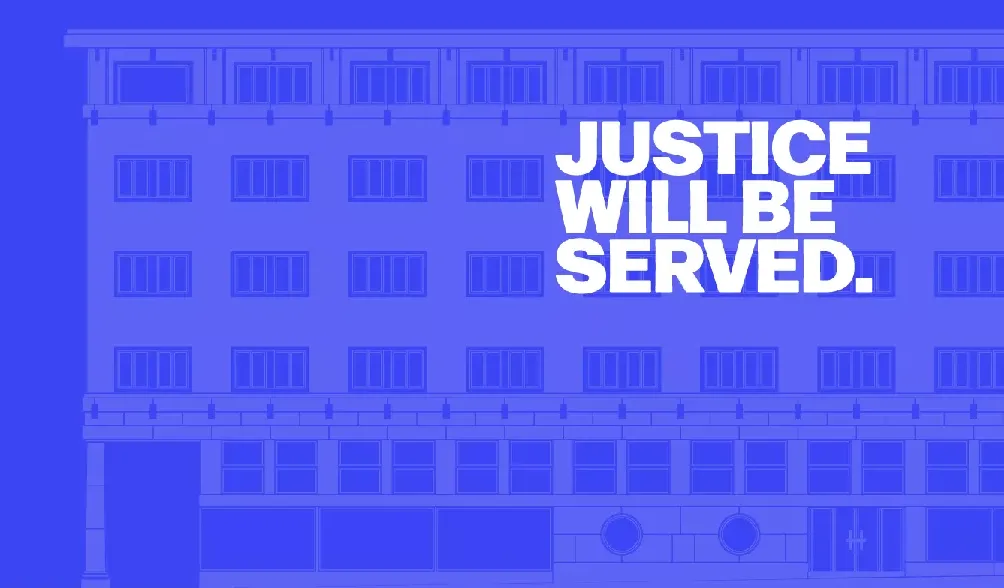
Wolfova 1: From dark history to new radiance with the House of Justice project
A symbol of success… then injustice and fraud
The building at Wolfovi ulici 1 in Ljubljani has become a symbol in which several historical moments intertwine. First it is a symbol of the extraordinary entrepreneurial success of the Mayer family in pre-war Slovenia, as the family built it during a period of great growth for our capital. Then it became a symbol of a terrible injustice that Emerik Mayer suffered at the hands of the communist authorities after the end of the war. And finally it is also a symbol of a terrible fraud that his daughter Doris Mayer experienced in independent Slovenia at the hands of her lawyer Tjaša Andree Prosenc.
The House of Justice project
The family heir Federico Pignatelli della Leonessa now wants to transform the building into a new symbol that, after exposing the dark chapters of its history, will shine again for a better future. He fights for his family’s rights and in doing so reveals the dirt of the Slovenian political and legal system that protects fraudsters. Therefore his struggle is not only a family matter; he is simultaneously fighting for changes that will allow Slovenia to breathe freely. He is also fighting for you. So that you would not suffer the injustice his family endured.
Federico Pignatelli has therefore launched the House of Justice project, with which he wants to transform the building at Wolfovi ulici 1 in Ljubljani into a symbol of the changes our homeland has long awaited. This is a fight for all those who suffer injustice because of corruption in the Slovenian judiciary. This is a project that will help restore the rule of law in Slovenia.
The publicly known side of the story
The dark side of the building’s history reads like a crime novel. The story of Wolfova 1 has in recent years become the subject of public debate primarily because of the revelation of the fraud perpetrated by the notorious lawyer Tjaša Andree Prosenc, who is a representative of a network of power that has persisted from the former communist regime. The story of the fraud and the dirty role played in it by the judicial authorities and the Odvetniška zbornica Slovenije is presented in numerous articles.
Original sin: asset seizure
Today we turn our attention to the first step of the terrible injustice that Emerik Mayer experienced because of this building. Because he helped partisan families during the war and protected them from the occupier, it never occurred to him to flee at the end of the war. He was a patriot who loved his homeland. He was a good man who helped others during the war. Nevertheless, he became a victim of communist crimes after the end of the war. They imprisoned him, tortured him and then brutally murdered him, and his family was driven out of Slovenia with nothing. Why? Because someone wanted to live at Wolfovi ulici 1. The original sin of the story of this building is its seizure after the end of the war.
The greed of the new rulers
After the end of the war, the communist authorities coveted the wealth of others, from artworks to real estate. Emerik Mayer and his family became victims of greed, as clearly evidenced by the document attached to this article. This document, which we present today, is clear proof of why the communist authorities seized the Mayer family’s property after the war and why one of the most successful pre-war families was driven out of Slovenia. This terrible injustice suffered by the family has not been rectified to this day. The evil done to the family is rooted in the document we reveal today and clearly demonstrates the reasons for that original sin that still burdens Wolfova 1.
An archival document proving the greed of the communist authorities
An archival document of the Commission for National Assets in Ljubljana lists those properties desired by the new rulers. They therefore tasked someone with finding excuses for the seizure of these properties. At that time, for owners this practically meant a death sentence, because otherwise it would have been difficult to justify the theft of properties that they claimed were needed for their ministers. The document very clearly presents how they conceived the matter: "Potrebni so nam podatki po katerih se bo lahko izvršila zaplemba imovine spodaj navedenih oseb…" The document also includes the bullet point: "Emerich Mayer z družino, Wolfova ul." Thus the property at Wolfova ulici was taken from the Mayer family by the post-war authorities, of course without judicial protection.
The ideology of seizures
After the end of the Second World War, the new authorities carried out an extensive process of reshaping property relations. Asset seizures were not limited to punishing individuals for collaboration with the occupier, but were part of a broader revolutionary ideological transformation aimed at reducing private property. Seizure procedures were carried out administratively, without individual court hearings and without effective legal remedies for the affected owners. Historiography notes that the boundaries between punitive measures and systematic nationalization were often blurred. Seizures affected many wealthier bourgeois families and property owners in urban centers, regardless of individual guilt. The communist revolution thus committed numerous crimes after the war.
The case of the Mayer family fits into this historical framework. The archival document of the Commission for National Assets, which explicitly names Emerik Mayer and his family and their property on Wolfova ulici, proves that the dispossession of property was not a random event but part of a broader system of post-war seizures. This action did not end with the seizure and the murder, but had long-term consequences for the Mayer family, which still has not experienced justice in the new independent state due to the preservation of power by former communist authorities. Wolfova ulica 1 is thus a concrete example of how post-war mechanisms intervened in an individual family story and marked it for generations.
Return with an embedded flaw
After Slovenia gained independence, the legislation allowed for the rectification of some post-war injustices. Within these procedures the property at Wolfova ulici 1 was returned to the heirs of Emerik Mayer, who was officially rehabilitated by his daughters in the eighties and proven with the help of witnesses that he did not collaborate with the occupier but on the contrary extensively helped partisan families. But this return of the property had an embedded flaw. The house was returned together with existing non-profit rental arrangements that had arisen during the period of social ownership. Ownership rights were only formally restored, while the actual relations in the building remained unchanged.
Moreover, among these non-profit tenants was the lawyer Tjaša Andree Prosenc, who then, with the help of corrupt networks in the Slovenian judiciary, defrauded the elderly and ill Doris Mayer. Federico Pignatelli emphasizes that the lawyer simply stole from the family the apartment in which she lived and the shop where her son Gregor Prosenc sells handbags. The lawyer, who should have cared for the interests of her client, betrayed her and obtained an extremely unlawful pecuniary benefit for herself and for her son, who is thus an accomplice in the fraud. Doris Mayer died in sorrow because her homeland betrayed her twice: first, when she was expelled from her beloved home after the war, and then again in the independent state when the justice authorities did not stand by her but allowed the lawyer to defraud her.
Wolfova 1 today: a new symbol of the fight for justice
The current owner of the property is Federico Pignatelli, who is the son of Doris Mayer and the grandson of Emerich Mayer. A businessman of global stature still cannot believe that Slovenia, after decades of independence and joining the circle of developed European countries, has not yet shaken off corruption and the dominance of former communist networks. The Wolfova 1 case reveals a broader problem of Slovenian transition. In many cases denationalization enabled legal recognition of ownership rights, but not actual and comprehensive restitution. The relations established during the period of social ownership remained in force and became the source of long-running disputes that continue to this day.
Wolfova ulica 1 is therefore not merely a building in the city center, but a witness to a complex history: injustices, silence, hope for justice and then new frauds based on power derived from the dark past of our homeland. Wolfova 1 is thus also a symbol of the crossroads on which today’s Slovenia stands. Will the injustices caused by evil people who draw their power from the past continue? Or will Slovenia finally breathe freely and achieve a system in which justice prevails? Federico Pignatelli fights for the latter. And he will not stop in this struggle until justice fully breathes again. That is why he has launched the House of Justice project, which you will be able to follow on this website.