
The same building, two injustices, one answer: “I will never give up.”
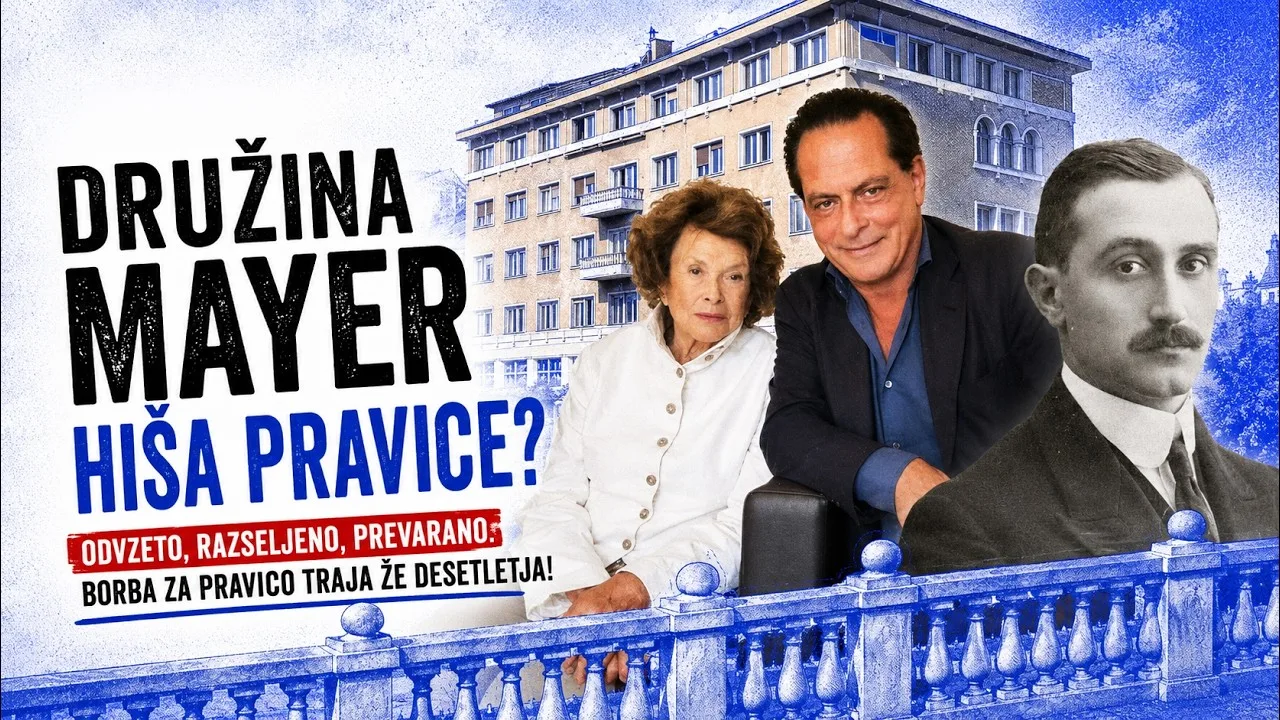
In the centre of Ljubljana stands a building constructed almost a hundred years ago by Emerik Mayer, a respected Ljubljana businessman. It is probably the largest building in the very heart of the city, but for Mayer's descendants it is more than a property. It is a reminder of a man whom his grandson Federico Pignatelli never met, yet has admired all his life.
In a new interview, Pignatelli speaks openly about how the same family was robbed twice. First after the war. And then again in independent, democratic Slovenia, by the very person he was paying to protect him.
The man who saved 22 Slovenian families
During the war, Emerik Mayer hid 22 Slovenian families from the occupying forces in his properties, supporting and caring for them. This is more than family tradition: descendants of the families he saved testified to it in court during the denationalisation proceedings. Instead of gratitude, an accusation followed after the war. A former director of his bank, whom Mayer had dismissed after catching him stealing money, reported him for collaborating with the Germans.
Imprisonment, torture and finally death followed. The consequences reached across three generations. His daughter Doris, Pignatelli's mother, spent several months in prison, where, according to her own testimony, she was abused and tortured. She was then sent across the Alps in the middle of winter, without shoes or possessions, and told to go and die in the mountains. She survived. An American soldier saved her, and her journey eventually took her to Rome, where she met Pignatelli's father.
The family scattered around the world. His aunt went to Brazil, where she taught German and Slovenian. His mother's brother made a new life in Ghana as an expert in marine life. His mother remained in Rome. All three had been born in Slovenia, yet none could stay there.
Only much later did the family discover what was said to have started it all: a representative of the Party liked the building and wanted to live in it.
Exoneration and a brief period of hope
After Slovenia gained independence, Pignatelli's aunt began proceedings to clear her father's name. Not to recover property, but to remove the stigma of being labelled a traitor and restore the family's reputation. The court reviewed the evidence, overturned the conviction and found Emerik Mayer innocent.
Only then did a lawyer point out a consequence that no one had considered: if the property had been confiscated because of the conviction, and the conviction no longer stood, it had to be returned to the heirs. Restitution was therefore a consequence, not the original aim.
The family recovered some properties and, at that time, believed that the Slovenian justice system worked.
A second theft
The heirs were scattered around the world and no longer had an emotional connection to Slovenia. For them, it was primarily the place of the family's tragedy, so they were willing to sell their shares. The only person who wanted to preserve the building as a whole was Federico Pignatelli, who therefore bought his relatives' shares himself.
He made the purchase through the Slovenian company Eurocapital Partners Estate, which lawyer Tjaša Andrée Prosenc had helped him establish. He was registered as its sole director, while she represented his interests in Slovenia.
The building was returned to the family together with the tenants who had already been living there and who, by law, paid non-profit rent. The lawyer was among them. In time, she asked Pignatelli whether he would sell her the apartment. He said no. Some time later, she asked again. The answer was always the same: the building was a whole, and nothing in it was for sale.
Then, he recounts, he discovered forged documents in the register. According to him, he had been removed as the sole director of his own company, and his mother had allegedly been registered in his place, without either his or her knowledge, under the name Doris Mayer Pignatelli. His mother's name was Doris Mayer, and she had never used that surname. A person who did not exist had therefore been registered as the company's director.
From then on, the same person was on both sides of the table. The building was undivided: one share belonged to his mother and the other to Federico's company, of which she had become the director on paper. What had previously been two sides had become one.
Then came the signatures. Doris Mayer was already elderly and seriously ill. She understood some Slovenian, having spent her childhood in Ljubljana, but that was far from understanding legal language. She signed documents whose contents she could not assess, believing they would help recover the rest of the family's property, including furniture and paintings. She believed she was doing something good for the family.
In fact, Pignatelli claims, those signatures were used to transfer two properties away from the family. The lawyer bought the apartment. Doris Mayer signed the contract on the seller's behalf, while the person buying the apartment, who was also the owner's authorised representative, allegedly prepared and managed the transaction. Two commercial units on the ground floor allegedly passed to her son, Gregor Prosenc, without payment. The purchase price was allegedly fictitious: money was said to have been taken from Doris Mayer's account and then presented as the official payment. According to Federico, neither the company nor his mother received anything.
The outcome was the same as decades earlier; only the route was different. Back then, the authorities had taken the building. This time, it was allegedly taken by the person who should have protected its owner.
A limitation period that protects the perpetrator
When Pignatelli learned what had happened, he immediately hired a new lawyer and filed a criminal complaint. Too late. The time limit for prosecution had been running from the date of the act and had already expired.
For Pignatelli, this is not a technical detail but the heart of the problem. If the victim does not even know about the offence, he asks, how can the clock run from the act itself rather than from the moment it is discovered? This creates a rule that rewards those who manage to keep quiet long enough. The perpetrator remains untouched, while the victim is left with years of civil litigation.
The cost is not merely personal. Corruption, he says, is a tax on top of taxes. It holds back the country's development, damages its credibility and deters foreign investors who see no guarantee that their property will be safe in Slovenia. In his view, the system remains under the influence of old power structures.
Why he travels with bodyguards, and why he still refuses to give up
He was advised to give up. The advice came from people who knew what they were talking about and put it to him kindly: the other side was well connected in Slovenia, while he had a life elsewhere and should look after it. He began travelling to Ljubljana with bodyguards. And every time, before starting his car, he checked it first.
None of this changed his resolve. He will not give up, he says, until there is justice. In memory of the grandfather he never met, the mother broken by betrayal, and the aunt and uncle who spent their lives far from home. He wants Tjaša Andrée Prosenc and Gregor Prosenc to answer for their actions, and he wants the properties back. Without compromise.
New hope: judicial reform
That is why he expects a great deal from the new government led by Prime Minister Janez Janša. He sees in him someone who knows what it means to stand up to the system, having himself been imprisoned as a result, yet returned to politics and won.
What matters most to him is what the new government has made a priority: fighting corruption and addressing the inefficiency of the justice system. He hopes that what has stood still for decades will finally begin to move, and that he will at last obtain justice.
What is Hiša pravice?
The project's name, House of Justice, says it all. Pignatelli wants the building that has twice been the target of injustice to become a symbol of justice in Slovenia. Not only justice for him and his family, but for everyone who has suffered an injustice. He wants it to represent the struggle for judicial reform and an end to political corruption.
Despite everything, his conviction remains. To him, Slovenia is one of the most beautiful countries in the world, with exceptional people, culture and preserved natural landscapes. He remembers the grey, dispirited city of the period after independence and compares it with Ljubljana today. He sees the future in the younger generation, which must take the helm.
For his family, justice would mean a rebirth. For Slovenia too, he says. Meanwhile, the building stands where it has stood for a hundred years, waiting.
Watch the interview
Federico Pignatelli speaks without embellishment. About his grandfather, who saved 22 families but was convicted as a traitor. About his mother, who was sent across the Alps without shoes to die. And about the day he saw a name in the register that did not exist.
Watch the full interview below.
Everything stated in this article about events following the return of the property is Federico Pignatelli's testimony, as given in the interview.